Extruded GasketsSilicone and EPDM, in coils or cut lengths
An extruded gasket is pushed through a die and cured continuously, so the section stays the same along its whole length. For a hollow section or a long one, it is usually the most economical way to make a gasket.
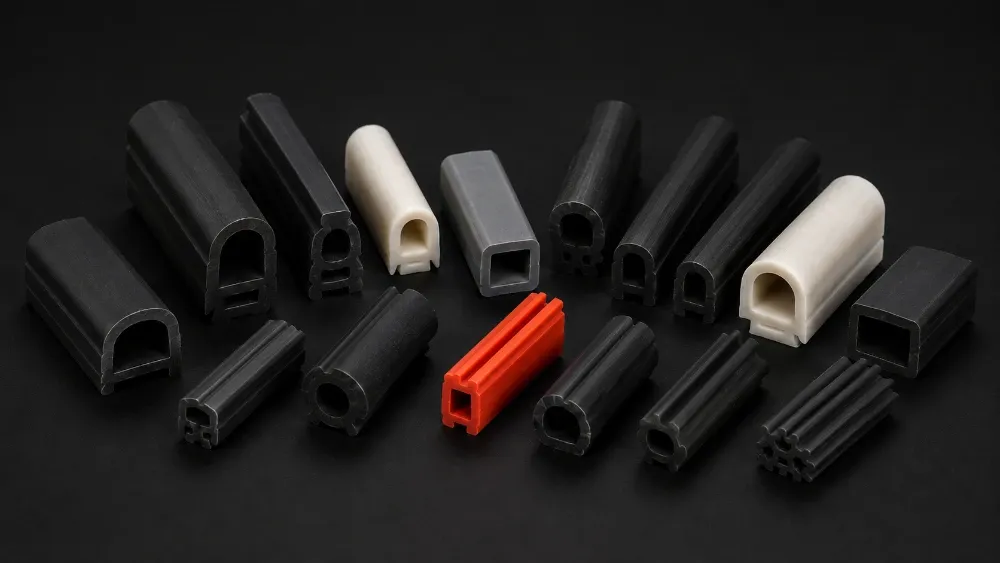
Sections, sizes and tolerances
We make A, D and P seals, solid sections and tubing.
- Sections
- A, D and P seals, solid sections, tubing
- Materials
- Silicone and EPDM
- Hardness
- Silicone from 30 Shore A, EPDM from 40, up to 85 Shore A
- Section size
- 0.8 mm smallest, 75 mm widest
- Thinnest wall
- 0.3 mm
- Tolerance
- ±0.15 mm on critical dimensions, ±0.3 mm on the rest and on sponge
- Supplied as
- Coils, or standard cut lengths
- Finishing
- Holes punched or shapes cut out on certain parts, as required
We do not supply self-adhesive backed profiles at the moment, and we do not notch. Other polymers, such as NBR, FKM and neoprene, we mould rather than extrude.
Extrusions that are not gaskets, such as edge protection, are on the rubber profiles page. Tube is on the silicone tubing page.
When to extrude, and when not to
A die costs a fraction of a mould. Ours start from ₹3,000 and take 2 to 3 days. That is why an extruded silicone gasket can come out cheaper than a moulded EPDM one.
The section is hollow. The gasket is large. Or the budget matters more than anything else.
The gasket is small or extremely critical, your line needs to fit it quickly, or the shape has tight radii that an extruded section would struggle to follow. See moulded gaskets.
You need a closed loop without paying for a mould. We cut the extrusion to length and join the ends. See joined gaskets.
Squeezing harder does not seal better
The most common mistake we see is over-compression. Every gasket section and compound is designed to work at a certain compression, and that figure depends heavily on the section itself. Push past it and the gasket does not seal any better. It gets cut, or it takes a set and fails sooner.
That is what went wrong in a luminaire job we did in 2019. The clamping was cutting the gasket, and the fix was a bigger hollow in the section. The full story is on the gaskets and seals page.
We do not publish compression figures. The right number depends on the compound, the groove, where the gasket fits and the section design, so a general figure would mislead more people than it helps. Send us the drawing and we will work it out for your part.
Two continuous curing lines
We run two continuous vulcanising lines. The first, with microwave curing, came in 2006, and it is the reason the company moved from Daspara to Liluah. The second, a hot-air line, followed in 2008.
How much we can make in a day depends on the section. A simple profile can run to about 12,000 metres a day. A heavy, complicated one might be 300.
Before any batch of compound reaches the extruder, it is checked for hardness, cure and porosity. If it has not been checked, it does not run.
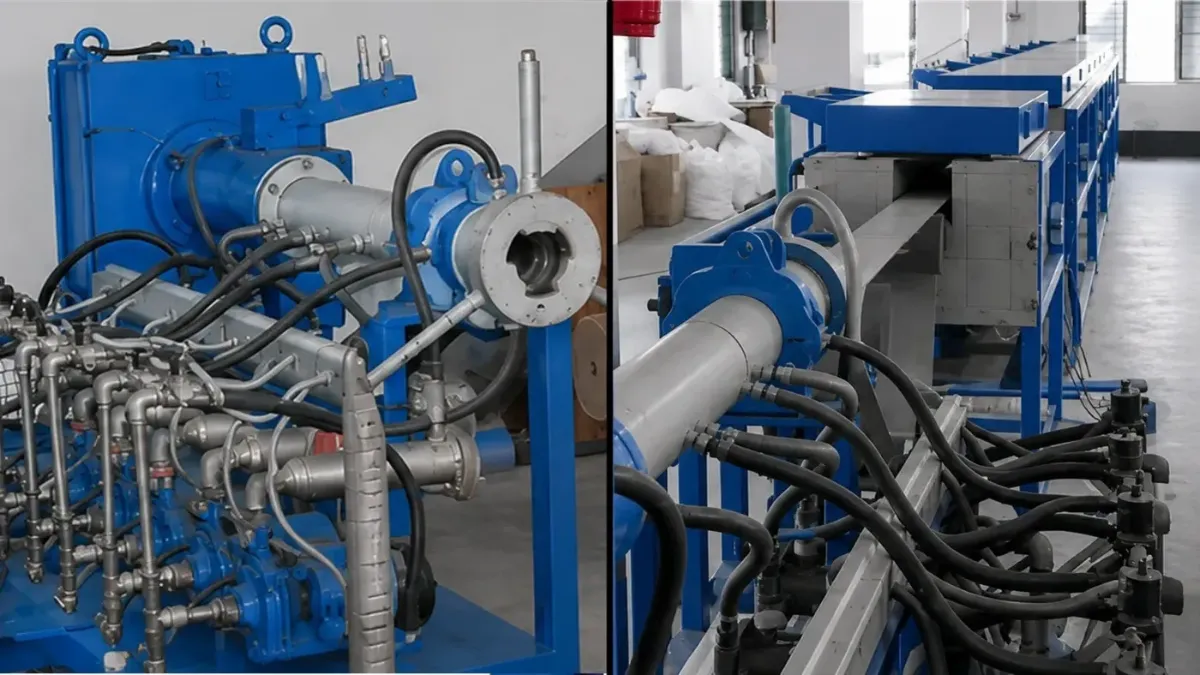
Extruded gaskets
The smallest section is 0.8 mm and the widest is 75 mm. The thinnest wall we can hold is 0.3 mm.
Send us your section
Send the drawing, a sample or a sketch of the groove. We will tell you whether to extrude it, what compound to use and what the die will cost.