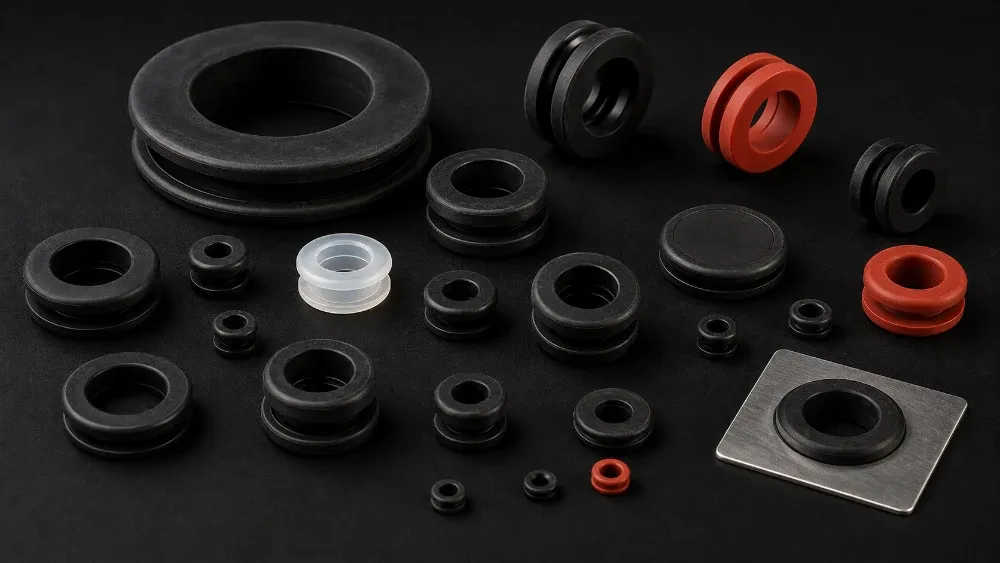
Rubber Grommets Cable, wire-entry and blind grommets
A grommet sits in a hole in your enclosure, and when your product goes for IP testing, the grommet is tested with it. Ours have passed IP66, IP67 and IP68 testing as part of our customers' products.
Seal performance depends on the complete assembly
Heat, ozone, incompatible media, mechanical stress and ageing can cause hardening or cracks. Confirm the compound and fit for the application; the required IP rating must be verified on the complete assembly.
Every batch of our compound is checked before it is used, and we do not bulk it out with cheap filler. Quality and consistency really matter to us at Silton. Read our Purity Promise.
Grommets, sizes and materials
Most of our grommets go to electronics and lighting manufacturers.
- Types
- Cable and wire-entry grommets, blind closed-membrane grommets for unused holes, and custom shapes
- Smallest
- For 3 mm wires, and 2 mm is possible
- Panel thickness
- From 0.8 mm
- Existing tooling
- Thousands of grommet models already made
- Fit
- Designed for your panel thickness and hole size
IP testing
A grommet does not get an IP rating on its own. The product does, with the grommet fitted. Our grommets have been through that testing: by us, by our customers and in lab tests.
When a standard grommet does not fit
If none of our existing grommets suits your hole, panel and cable, we make one that does, to your application. See custom parts.
Rubber grommets
An IP rating belongs to the finished product, not the grommet alone. Our grommets have passed IP66, IP67 and IP68 testing as part of our customers' products, tested by us, by customers and in labs.
Send us the hole, the panel and the cable
Send the hole size, panel thickness and cable diameter, or a drawing. We will check our existing grommets first.