Joined GasketsExtruded lengths made into endless loops
A joined gasket starts as an extrusion, is cut to length and has its ends joined into a closed loop. For a large gasket it can cost a fraction of a moulded one.
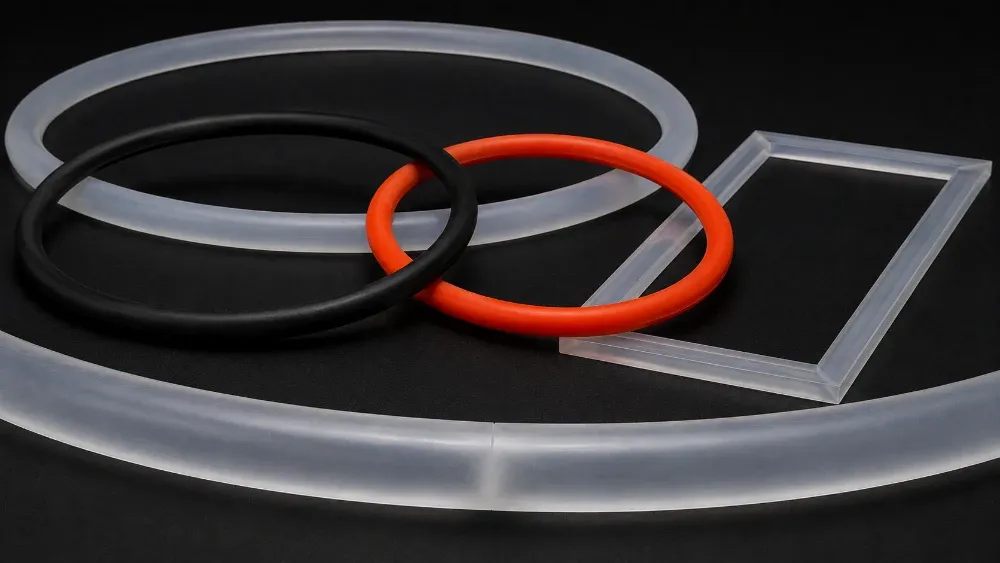
Silicone joints use no glue. Thin EPDM joints do.
How we join a gasket depends on the material and the thickness of the section.
Joined with uncured silicone compound and cured in a small joining mould. The joint is silicone cured to silicone, with no glue in it, so it stays as compressible and heat-resistant as the rest of the gasket.
Joined by moulding, in the same way.
Vulcanised EPDM to EPDM. This works well in thick sections.
Bonded with cyanoacrylate. The joint is slightly stiffer than the profile but holds well. We rate these joints to 80°C, the limit the adhesive maker gives.
Every joint is pull-tested
We check 100% of joints. Each one is pulled to look for peeling edges or any flaw at the bond, and we are strict about it.
A good joint is very strong. In our testing, a joint sometimes comes out stronger than the profile itself. On some gaskets you will have trouble finding the joint at all. On others you will see a fine line, and nothing more.
RTV holds until the first time it gets hot
Some manufacturers join gaskets themselves with RTV silicone sealant or glue. It looks fine when it is done. Then the product heats up in use and the joint lets go.
A joint made in our factory takes that labour off your assembly line, and every loop comes out the same as the one before it.
An 800 mm gasket does not need an 800 mm mould
Mould costs climb steeply once a gasket gets big, and because rubber has to cure in the press, each cycle is slow. An 800 mm diameter gasket is expensive to mould on an ongoing basis. The same gasket extruded and joined can be very cheap, and the extrusion die starts from ₹3,000.
- Minimum length
- 200 mm
- Maximum length
- No upper limit
- Capacity
- About 4,000 joints a day
- Sections
- A, D, P and custom sections
- Corners
- Mitred 45° or other corner joints on request
- Tightest corner
- Depends on the section and material, so we do not quote a general figure
Joined gaskets
Not in silicone. Silicone joints are made with uncured silicone compound and cured in a joining mould. Thick EPDM sections are vulcanised EPDM to EPDM. Thin EPDM sections are bonded with cyanoacrylate.
Send us the size of the loop
Send the drawing or the inside dimensions, the section and the material. We will tell you how we would join it and what it will cost.