Sponge GasketsClosed-cell silicone and EPDM
Sponge seals with far less force than solid rubber. It suits lids and doors that cannot be clamped hard, and castings that are not perfectly flat.
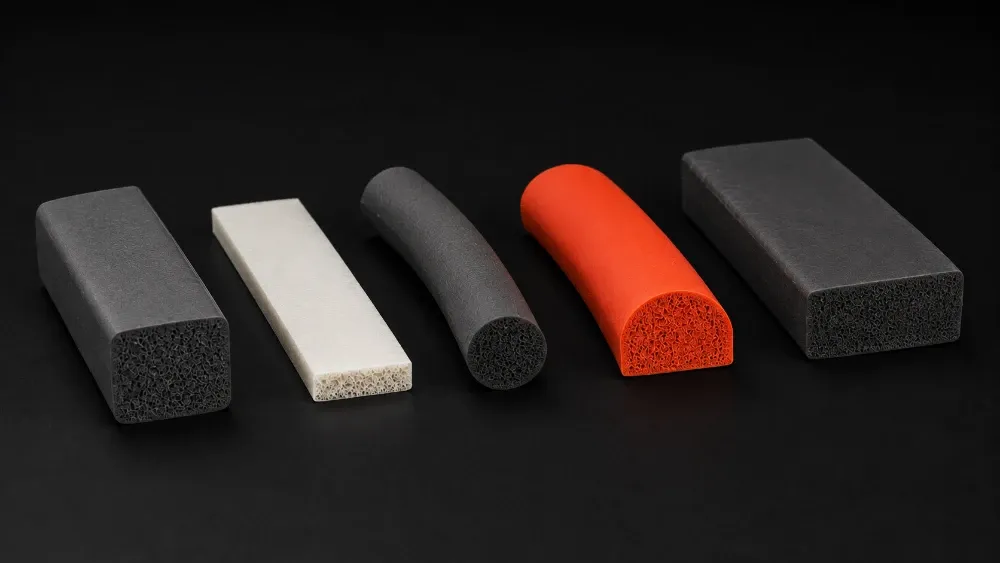
What sponge does better than solid
We make closed-cell sponge only.
For the same volume of seal, sponge costs less than solid rubber. The saving is per unit of volume, not necessarily per metre.
It squeezes down further, so it can take up bigger gaps.
It gives where the casting is uneven or the clamping is not even all the way round.
Light doors and thin lids close properly without heavy clamping.
What it gives up: sponge usually has a worse compression set than a solid gasket. If a joint will stay clamped hard for years, ask us whether solid is the better choice.
Above 100°C, silicone. Below it, EPDM.
The choice usually comes down to temperature.
-60°C to +200°C. Sun, ozone and heat cycling do very little to it. Use it when the temperature goes above 100°C.
-40°C to +100°C. The usual choice when the temperature stays below 100°C.
What we make
We grade our sponge as soft, medium or firm. Tell us what the gasket has to do and we will pick the grade.
- Cell structure
- Closed cell only
- Grades
- Soft, medium and firm
- Section size
- About 3 mm to about 40 mm
- Tolerance
- ±0.3 mm on extruded sponge
- Loops
- Silicone sponge joined into loops by moulding
- Longest part
- A 25 m step-moulded silicone sponge part
Sponge gaskets
No. We make closed-cell sponge only.
Tell us what the gasket has to close against
Send the drawing or a photo of the door, lid or casting, and the temperature it sees. We will suggest a section, a material and a grade.