O-RingsFrom 1 mm ID to 7000 mm across
An O-ring is one of the cheapest parts in a machine. When it fails, what it costs you is the downtime and the labour of getting the old one out and a new one in, and O-rings are rarely easy to reach.
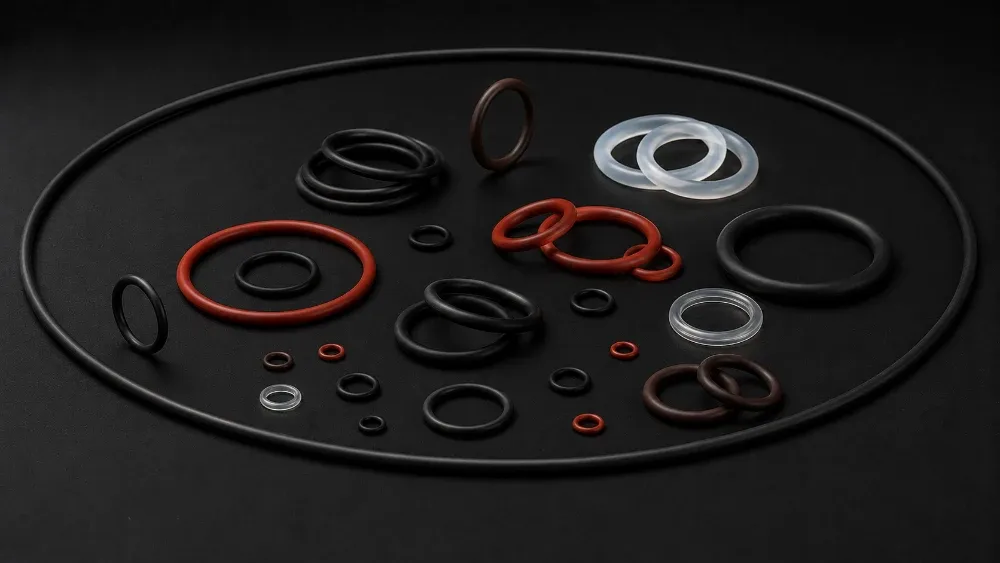
Sizes, grades and tooling
We already hold over 3,000 O-ring moulds, so there is a good chance your size needs no new tooling. The largest O-ring we have made is 7000 mm in diameter.
- Existing moulds
- Over 3,000, covering BS 1806, ISO 3601 and metric sizes
- Smallest
- 1 mm ID
- Largest
- 7000 mm diameter
- Cross-section
- About 0.8 mm to 25 mm
- Temperature
- -60°C to +230°C, depending on the polymer
- Grades
- Silicone including flame-retardant, food-grade FKM, NBR, high-temperature and acid-resistant grades
- Fuel grades
- Ethanol-resistant compounds for E20 and E85
- Repeat orders
- Usually very quick, depending on our workload
10% more on the O-ring. 1.5 times the life.
On a small O-ring, the compound is a very small part of what the O-ring costs. It is also the part some makers cut, and that is where compression set failures, leaks and downtime come from.
In our experience, an O-ring made properly may cost about 10% more and last 1.5 times as long or longer. Neither number comes close to what you spend when a machine stops and someone has to change an O-ring that was never easy to fit.
White filler and skipped post-curing
The failure we see most is an O-ring that has had white mineral filler added to make it cheaper. Its compression set is poor, it takes a set in the groove, and it stops sealing.
The second is post-curing. Many compounds need it to reach their compression set properties, and very few makers do it the way they should. We post-cure where the compound and the application need it. That covers most silicone parts, and the O-rings that call for it.
Our Purity Promise explains how we deal with filler, and you can ask us for the ash content of your O-rings.
You know who made it
Buy from us and you know who mixed the compound and who moulded the part, because both happen here. Every batch of compound is checked for hardness, cure and porosity before it is used, and every cavity of a mould is checked before production starts. More on that is on the moulded gaskets page.
O-rings
From 1 mm ID up to 7000 mm in diameter, with cross-sections from about 0.8 mm to 25 mm.
Send us the size and what it seals
Send the ID and cross-section, or the standard size, with what the O-ring seals against and at what temperature. We will suggest a compound and check whether we already have the mould.